
Buying and selling regulated businesses – Key factors to ensure a successful transaction
18 Jun 2024 • Business Services • Financial Services • Insight • Regulatory Reporting
Written by


The asset management industry has seen numerous mergers, acquisitions, and consolidations in recent years. The complexities of these transactions can provide a myriad of challenges, not least, the requirement for regulatory approval.
As seen in the AIMA journal - Edition 138
A ‘Change in Control’ application is thorough and demands considerable resource and time. Incomplete, or inaccurate, applications can delay the entire process, highlighting just how important it is to get everything lined up from the outset. In this article, we explore how utilising ‘change management practices’, ‘strategic planning’, and ‘proactive measures’ can help you manage, as well as mitigate, risks and unlock the full potential of the combined businesses through a smooth regulatory integration.
Essential to the smooth completion of a transaction are preparation and planning, execution and measurement, and communication and feedback. It is also key to understand how the Financial Conduct Authority (FCA) approaches a Change in Control application and what information they need before approving. When the above considerations are applied to the tasks at hand, challenges can be addressed thoroughly and greater outcomes can be achieved.
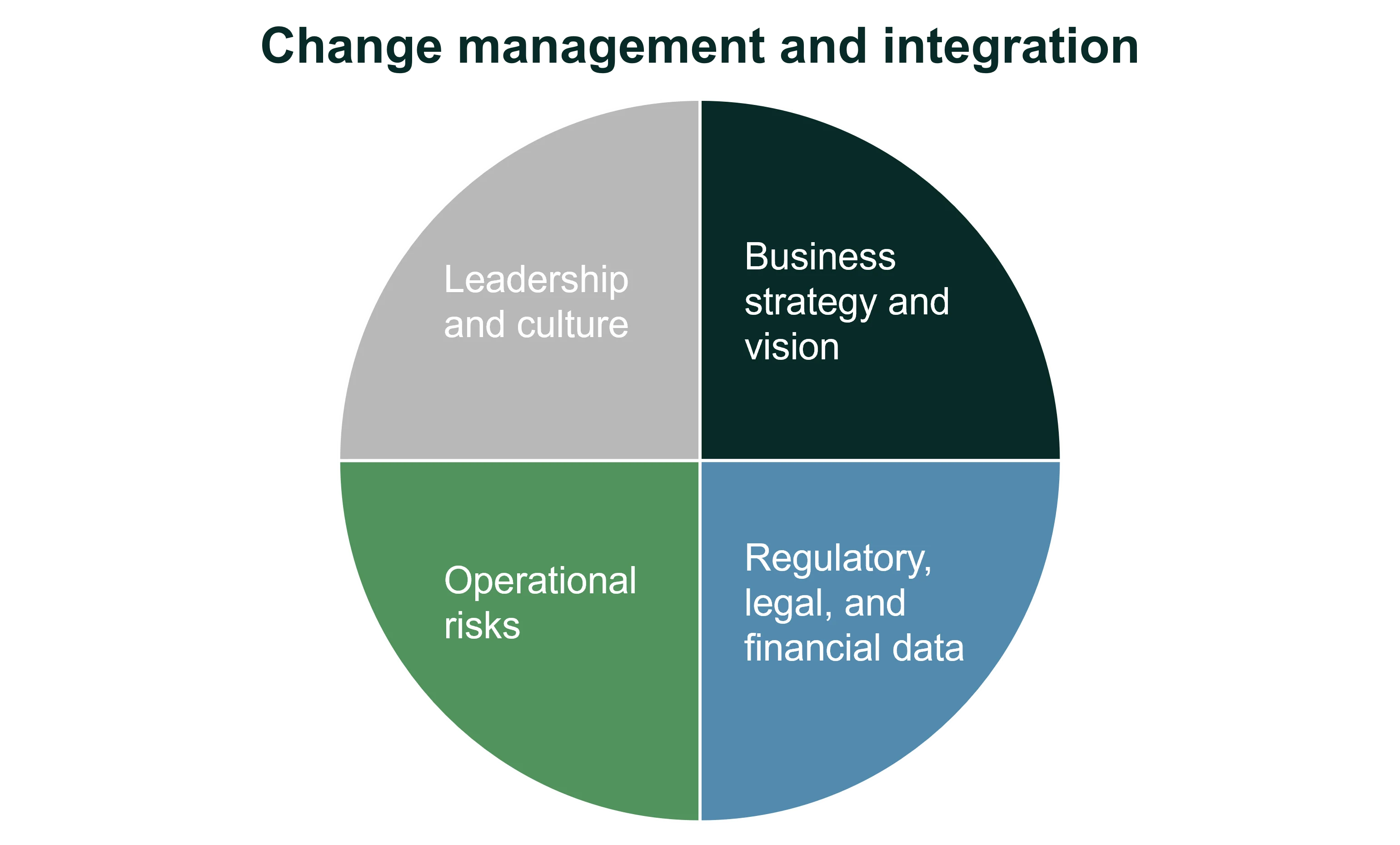
The below diagram outlines the four key considerations for successful change management and integration.
Business strategy and vision
The foundation of a successful application to the FCA is the clarity and completeness of the regulatory business plan. The plan should articulate details of the target firm as well as the acquiring firm and, as a minimum, should cover the following key points:
Background of the target firm in terms of description of business activities, prudential classification, and regulatory permissions.
Background of the proposed controllers with a detailed history of previous acquisitions, as well as explaining how the target firm would fit in and enhance the acquiring firm’s business.
Augmentation of the new investment process, long-term aims in relation to the target firm, and anticipated changes in global regulatory footprint focusing on the overall aim of the proposed acquisition.
Financial goals of the proposed acquisition (i.e., return on equity, cost-benefit ratio, earnings per share or in other terms).
Possible redirection of activities, products, targeted customers, as well as possible reallocation of funds or resources expected to impact the target firm.
The integration plans for the target firm within the proposed acquirer’s group structure.
Information about the impact of the acquisition on the target firm’s corporate governance and general organisational structure.
A clear, well-thought-through business strategy is not just essential for a successful application however, it will also ensure long-term success for the integration. Having a clear vision will ensure that the goals and measures of success are clear and will act as a guiding north star for those in the business.
Regulatory, legal, and financial data
Demonstrating prudential regulatory compliance over capital adequacy and liquidity requirements through comprehensive and well-integrated financial data is vital for the FCA’s approval. You should include the following:
Transparency of information flow between the balance-sheet, profit and loss account, and cashflow statements of all entities, ironing out any anomalies potentially caused by different accounting conventions or Generally Accepted Accounting Principles (GAAPs).
The firm’s assessment of its capital and liquidity thresholds, and evidence that the business will have sufficient financial resources to meet these requirements going forward.
The preparation of the post-acquisition Internal Capital Adequacy and Risk Assessment (ICARA) process and wind-down planning documentation.
Financial and capital projections, including stress- and reverse stress-testing.
Establishment of processes relating to financial planning and analysis, financial reporting, regulatory monitoring, treasury and liquidity management, and group structure impact.
Incorporation of the applicable local laws, tax planning, licencing, and registrations.
Operational tasks
Implementing robust processes, enabling flexible ways of working and planning, and empowering people across the organisation are crucial elements of successful integrations. A resilient operating model not only sets the future organisation up for success, but it also ensures that the organisation complies with regulatory requirements across a variety of business units. Various functions across the business have the potential to impact operational efficiency in differing ways during a merger or acquisition:
Business-As-Usual (BAU) processes:
Ensuring that investment processes, portfolio management, trade execution, asset administration, and investment performance and risk measurement continue in an unaffected way is key. Other activities such as product management and brand and marketing can also be impacted by a merger or acquisition and will need to be managed effectively, so as not to have a negative impact.
Systems and technology:
From a business continuity and future growth perspective, it is hugely important to get the right systems and technology in place. This could be anything from IT support, data integrity management, agile ways of working, change management & BAU conflict, third-party contingency & exit, vendor and service provider change, and business continuity & crisis management.
People:
This is one of the most crucial elements to get right in any merger or acquisition, because while processes and technology can help a business, it’s the people that power change. Strategic workforce planning – which is the act of truly understanding what skills and people are needed to deliver on the business strategy – is an important activity to undertake. From there, you’ll also need to consider activities such as recruitment, training, employer brand, HR and employee relationships, and how to manage changes in reporting lines.
Finance:
To ensure operational efficiency, it is important to get the finance function up and running; considering new accounting systems and data mapping, management information systems, and various other activities is key.
Leadership and culture
Finally, firms will also need to prioritise their leadership and culture to support a merger or an acquisition. It is essential to increase synergy between the two firms, but also to create an organisation that people want to work for and with.
Focusing on future-focused leadership capabilities will ensure a more successful experience post-integration. Senior members of staff should be able to not only successfully execute and deliver the earlier mentioned business strategies, but they should also be able to meet the Senior Managers and Certification Regime (SM&CR) requirements of the FCA.
In addition, they should also be able to lead with empathy and create adaptive and blended cultures. Communication is a big part of this – breaking down barriers of communication between the target and acquiring firm, and between various vendors and service providers is crucial. Alongside this, being able to communicate the new vision and strategy for the firm will ensure that everyone knows what they are working towards. It’s important to remember that for global asset managers, there may be a difference in geographical locations. If this is the case, combatting and embracing any cultural difference is another important point to note in order to contribute to a healthy working relationship.
In summary
The FCA’s stamp of approval over a transaction is a game changer. It generates momentum and introduces unique challenges for each subsequent action upon which other tasks rely. However, as mentioned earlier, if the application is incomplete or inaccurate, the FCA can delay the process.
Identifying the additional or differing reporting requirements of the new market, firm, or merger will help ensure an efficient FCA approval process. A personalised checklist can be created by working with your network of advisors. Creating a checklist can ensure all considerations are covered, and then, through ample communication, each task can be assigned to employees, and roles can be discussed. This will be an efficient method of creating employee synergy while meeting deadlines. From a regulatory compliance standpoint, it is also important to consider immediate priorities post-acquisition. In our experience, those are:
New entity names, a new website, and any redirection from old ones
Novation of agreements
Public disclosures
Sufficient capital and liquidity
Remuneration policies in line with the legislation
Procedures or governance for monitoring requirements and collecting the relevant data
Ensuring that you have employees with the relevant knowledge or experience
Combined ICARA and wind-down process
Risk assessment considering the new control environment
Understanding and rightsizing the network of advisors and service providers – ensuring there are no gaps or duplication
Contact us
We're here to help - whether you have a question, need advice, or want to tell us about your requirements.