
Autumn Budget 2026: what HMRC’s changing compliance and debt recovery approach means for taxpayers
News • Tax Disputes and Investigations
Written by

While there were relatively few headline changes from a Tax Investigations perspective, the Autumn Budget leaves little doubt about the direction HMRC is taking. In this article, we explore what the announcement could mean for businesses and individuals, and why taking a proactive approach to historic tax affairs is becoming increasingly important.
The measures announced are aimed at increasing tax collection, reducing the tax gap and strengthening HMRC’s compliance capabilities. Collectively, they point towards broader access to information, stronger powers to require taxpayers to correct their position and more robust ways of collecting established tax liabilities.
For most taxpayers, there is unlikely to be an immediate change in the way they interact with HMRC. Over time, however, HMRC will be even better placed to identify inaccuracies, require them to be corrected and recover what is owed. Historic errors that might once have gone undetected are increasingly likely to be found, and those who wait for HMRC to make contact may find themselves with less control over the outcome, and on less favourable terms, than those who come forward voluntarily.
A greater expectation to identify and correct errors
One measure to watch particularly closely is the proposed requirement for taxpayers to correct inaccurate returns and documents from April 2028.
Once introduced, HMRC will be able to issue Customer Correction Notices where it suspects an inaccuracy. In practice, this will put taxpayers on notice that there may be an issue with their tax affairs and that their position requires review.
Encouraging taxpayers to identify and correct genuine errors is sensible. However, the important question will be what is expected of a taxpayer once HMRC has raised a concern.
Where someone is put on notice of a potential inaccuracy but does not take reasonable steps to investigate or correct their position, there is a risk that HMRC could seek to argue that any subsequent failure to correct was deliberate. That could result in higher penalties, longer assessment periods and potentially more serious investigations.
The detail and safeguards accompanying the new requirements will therefore be important.
HMRC is strengthening its approach to debt recovery
The Budget also points towards a more automated approach to collecting established tax debts.
HMRC can already recover certain established tax debts directly from bank accounts, but the new proposals, expected to be introduced from 2029/30, would go further by enabling lower-value debts to be collected directly from bank accounts where taxpayers repeatedly fail to engage. This points towards a more automated approach to debt collection and makes early engagement with HMRC increasingly important.
As part of the consultation previously released on these measures, HMRC estimated that around 750,000 lower-value debts worth more than £2 billion are returned from debt collection agencies each year without successful collection. It also estimated that millions of taxpayers will have debts eligible for direct recovery under the proposed measures.
For taxpayers with existing tax debts, early engagement with HMRC will be increasingly important as its focus on debt recovery and collection grows.
The wider context: closing the tax gap
These measures form part of HMRC’s broader efforts to tackle the tax gap.
HMRC data included in Buzzacott’s Autumn Budget analysis puts the tax gap at £59.2 billion in 2024/25, equivalent to 6.4% of theoretical tax liabilities. Of this, £20.8 billion related to failure to take reasonable care, £9.3 billion to error and £6.9 billion to legal interpretation. Together, those three categories account for £37 billion, or 62.5% of the overall gap.
The UK tax gap increased to £59.2bn in 2024/25
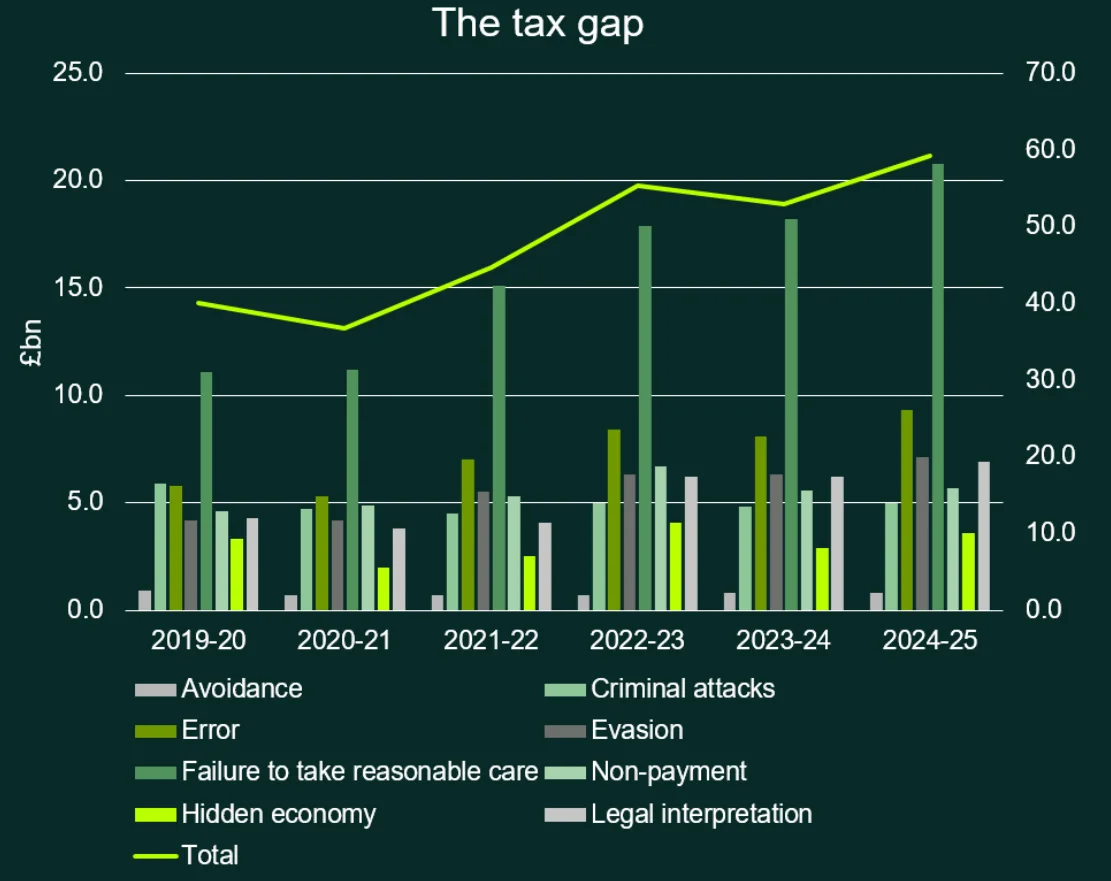
Figure 1. The UK tax gap by behaviour, 2019/20 to 2024/25. Source: HMRC data reproduced in Buzzacott’s Autumn Budget 2026 presentation.
That context is significant. Non-compliance is not solely about deliberate evasion or criminal behaviour. HMRC’s figures show substantial amounts attributed to innocent errors and failures to take reasonable care, helping to explain the growing emphasis on taxpayers reviewing their affairs and correcting inaccuracies when they arise.
What does this mean for taxpayers?
For most businesses and individuals, the announcements do not require an immediate change in how they deal with HMRC.
However, they reinforce the importance of maintaining good records, seeking appropriate advice and engaging promptly if HMRC raises a question or concern. Taxpayers who do should be well placed to deal with the new measures, even if they become subject to an enquiry or compliance check.
The environment will be more challenging for those who ignore HMRC correspondence, fail to engage, participate in avoidance arrangements or knowingly leave errors uncorrected.
Important questions remain about how the measures will work in practice, including what the legal requirement to correct errors will require of taxpayers, how and when HMRC will be able to recover established tax debts through deductions from bank accounts and how changes in personal circumstances will be considered in debt recovery action or Time to Pay arrangements.
The headline announcements only tell part of the story. Their practical impact will depend on the detail of how the measures operate and the safeguards that accompany them.
What should you consider now?
The Autumn Budget may not have produced a single headline-grabbing change for tax investigations, but taken together, the measures give HMRC more tools to identify non-compliance, require taxpayers to correct their position and recover tax that is already due.
Now is a sensible time for businesses and individuals to take stock of their historic tax position. Where there is any uncertainty over whether previous returns are correct, a proactive review before HMRC makes contact allows issues to be identified and resolved on the taxpayer’s own terms, and can significantly reduce any penalties that may apply.
For those with existing tax debts, early engagement with HMRC is crucial. With a greater focus on debt recovery, those who wait for HMRC to pursue the debt are likely to find they have fewer options available.
How we can help
If you are concerned about a historic tax position, have received correspondence from HMRC or would like to understand how the Autumn Budget measures could affect you, our Tax Disputes and Investigations team can help. Please fill in the form below and a member of the team will be in touch.
Contact us
We're here to help - whether you have a question, need advice, or want to tell us about your requirements.