
How will the new financial reporting thresholds impact your charity from 30 September?
2 Sep 2026 • Charities and Not-For-Profits • Charity and Not-For-Profit Audit
Written by

Following public consultation, the UK Government has confirmed significant changes to the accounting and reporting requirements for charities, with the aim of reducing the administrative burden and expense for smaller charities.
These changes introduce new thresholds governing the external scrutiny of annual accounts. They come alongside the introduction of SORP 2026, which brings wider changes to charity financial reporting.
The changes to the thresholds will come into effect on 30 September 2026, and will apply to accounting years ending on or after this date
The new thresholds
The following table summarises the new thresholds:
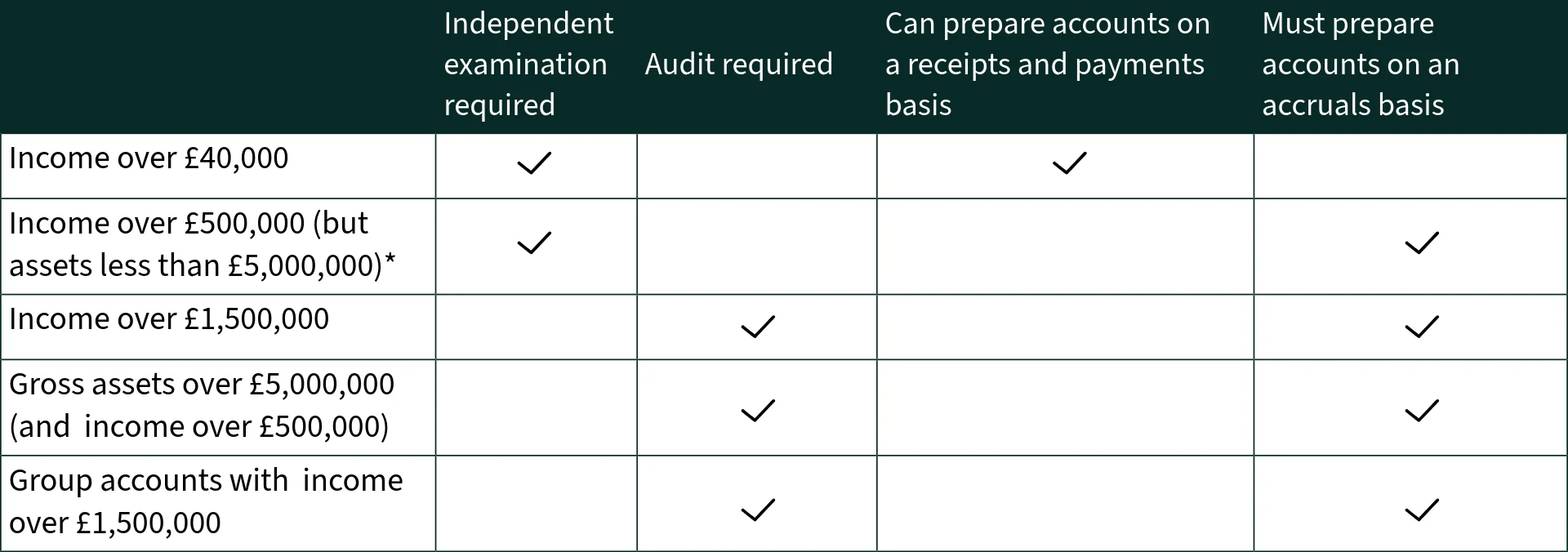
* If the charity has annual income of more than £500,000, the independent examination must be conducted by a qualified independent examiner. If income is less than £500,000, the independent examiner does not need to be qualified.
The threshold at which a charity must be registered with the Charity Commission remains at £5,000 and the threshold for submitting an annual return remains at £25,000.
It is important to note that all charities must prepare accounts and make them available on request (regardless of whether they are registered with the Charity Commission).
Key difference between an independent examination and an audit
An independent examination provides a lower level of external scrutiny than an audit and is designed to be a simpler and more cost-effective review of a charity's accounts. The independent examiner considers whether there is any evidence that the accounts have not been properly prepared and whether they are consistent with the accounting records made available to them. However, they do not carry out the detailed testing and verification procedures required as part of an audit.
An audit provides a higher level of assurance. Auditors perform detailed testing of transactions, balances and controls, assess areas of significant judgement, and gather evidence to support an independent opinion on whether the financial statements give a true and fair view.
Why a full independent audit may still be desired or required
If the charity does not breach the thresholds for an audit, one may still be required or desired for a number of reasons:
A charity’s governing document may stipulate that an audit is required
Audited accounts may be required by funders or banks, therefore, contracts and agreements should be reviewed carefully
The trustees may wish to have their accounts audited to provide additional assurance and scrutiny over the figures being reported
If the charity is close to the threshold and may breach it in certain years but not others, it may be more efficient and cost-effective to continue with an audit each year rather than alternating between an independent examination and an audit
So what?
The new thresholds represent one of the most significant revisions to charity reporting requirements for many years. While they will reduce the compliance burden for some charities, trustees should consider carefully whether a lower level of external scrutiny remains appropriate for their organisation.
Charities should assess whether they are likely to be impacted by the threshold changes by reviewing their budgets and forecasts for the affected periods. If there are changes to the level of scrutiny required, consider the best approach for the charity that factors in the users of the financial statements, the charity’s future, and cost implications.
Buzzacott’s Charity and Not-for-Profit team can help charities assess how the revised thresholds affect their reporting and external scrutiny requirements and consider the most appropriate form of assurance.
Contact us
We're here to help - whether you have a question, need advice, or want to tell us about your requirements.