
Financial benchmarking report for professional bodies 2026
1 Jul 2026 • Audit and Assurance • Charities and Not-For-Profits • Charity and Not-For-Profit Audit • Insight
Written by



We’re pleased to have collaborated with PARN for the first time on this financial benchmarking report for professional bodies. This report is PARN’s 16th edition and offers insights based on our extensive experience in the sector, PARN’s research base, and this year’s survey findings.
Professional bodies operate within a complex and evolving environment, with diverse income streams and service offerings, alongside varied membership structures. While many face common financial and economic pressures, their membership-based models and regulatory responsibilities create distinct operational and financial dynamics.
This report provides insight into current sector trends based on information for financial year ends between end of July 2024 and end of June 2025.
It is designed to support boards, senior leadership teams, and finance professionals in understanding how their organisation compares with sector benchmarks, and in identifying areas of relative strength, opportunity, and potential risk.
Key messages
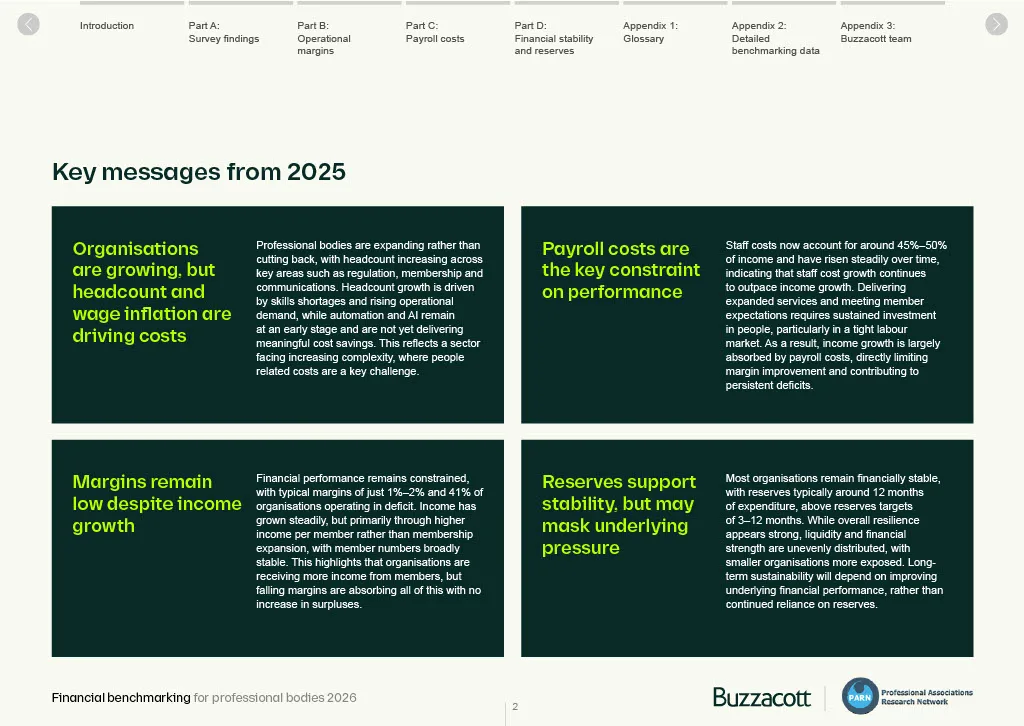
Organisations are growing, but headcount and wage inflation are driving costs:
Professional bodies are expanding rather than cutting back, with headcount increasing across key areas such as regulation, membership and communications. Headcount growth is driven by skills shortages and rising operational demand, while automation and AI remain at an early stage and are not yet delivering meaningful cost savings. This reflects a sector facing increasing complexity, where people related costs are a key challenge.
Payroll costs are the key constraint on performance
Staff costs now account for around 45%–50% of income and have risen steadily over time, indicating that staff cost growth continues to outpace income growth. Delivering expanded services and meeting member expectations requires sustained investment in people, particularly in a tight labour market. As a result, income growth is largely absorbed by payroll costs, directly limiting margin improvement and contributing to persistent deficits.
Margins remain low despite income growth
Financial performance remains constrained, with typical margins of just 1%–2% and 41% of organisations operating in deficit. Income has grown steadily, but primarily through higher income per member rather than membership expansion, with member numbers broadly stable. This highlights that organisations are receiving more income from members, but falling margins are absorbing all of this with no increase in surpluses.
Reserves support stability, but may mask underlying pressure
Most organisations remain financially stable, with reserves typically around 12 months of expenditure, above reserves targets of 3–12 months. While overall resilience appears strong, liquidity and financial strength are unevenly distributed, with smaller organisations more exposed. Long-term sustainability will depend on improving underlying financial performance, rather than continued reliance on reserves.
Preview the report

About the report
The contents of this report is presented to offer firms the opportunity to benchmark their current position with that of the rest of the market with a theme of ‘Doing more with less: Strategic cost optimisation for professional bodies’. To gather the information on this topic, research was undertaken to examine professional bodies and how they manage operational costs, utilise AI and automation and outsource efficiently.
This report is based on financial and organisational data extracted from the returns made by 500 UK-based professional bodies, from their annual reports or reviews along with financial statements available from either their websites, the Charity Commission or Companies House.