
Academy Trust Handbook 2026: What do trusts need to know ahead of 1 October?
24 Jul 2026 • Charities and Not-For-Profits • Charity and Not-For-Profit Audit • Education • Insight


The Academy Trust Handbook 2026 was published on 15 July 2026 and introduces a number of updates which trusts will be required to adhere to from 1 October 2026.
This article outlines the key changes and steps that leaders should be taking to ensure that compliance can be demonstrated from the start of the new academic year.
The key changes can broadly be grouped into three categories:
New procurement requirements
Policies and responsibilities
Pay and benefits
Trusts should review these changes alongside existing processes and procedures to ensure that key stakeholders are aware of these new requirements from 1 October 2026.
Should any further guidance be needed, our Charity and Not-for-Profit team has academy specialists who are available to discuss considerations with you in more detail. Please get in touch using the form below. You can find the full guidance is available here.
New procurement requirements
These updates place a greater emphasis on evidencing procurement decisions and ensuring trusts use DfE-approved routes or demonstrate comparable value where alternatives are used.
The handbook has introduced a new “must” requirement for trusts to consider DfE opportunities (Get Help Buying for Schools) when making purchasing decisions. Schools should consider how this can be evidenced, and whether any changes should be introduced to procurement templates to ensure an audit trail relating to purchasing decisions is present.
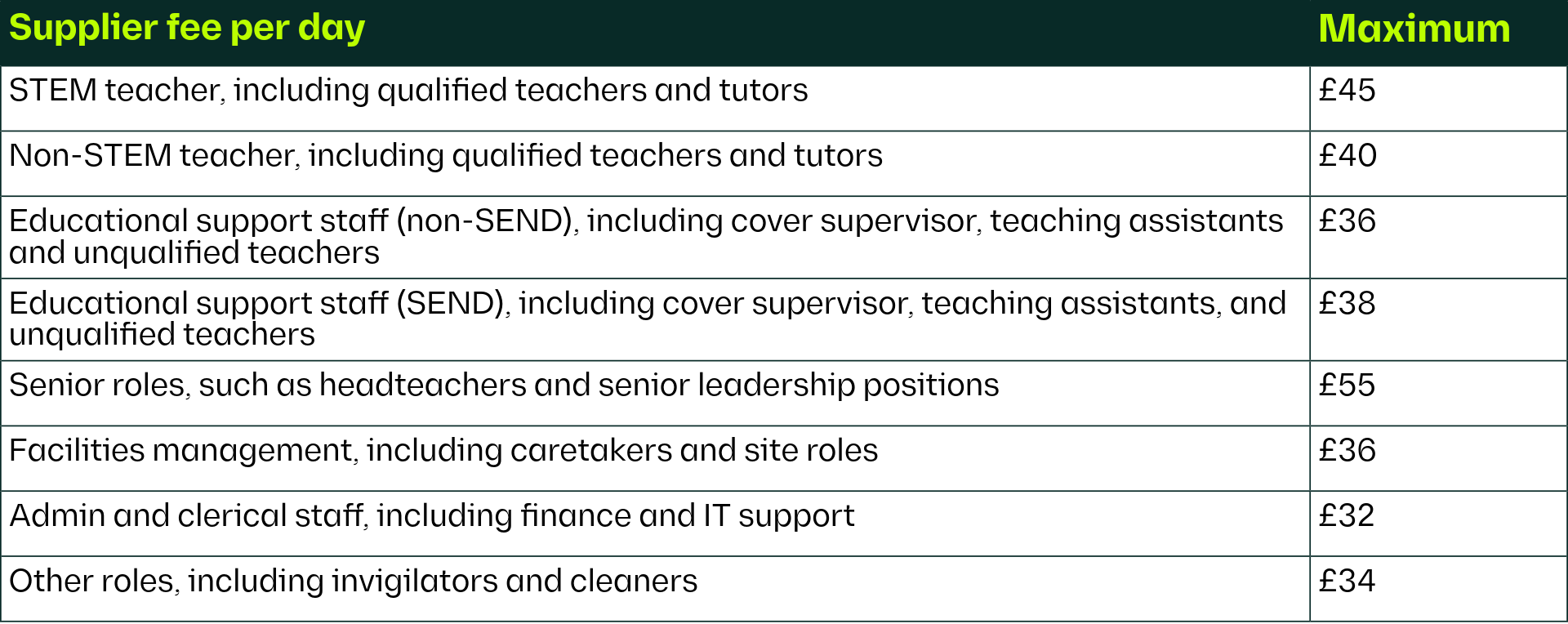
Trusts must use the Government Commercial Agency (GCA), Supply Teachers, and Education Recruitment for their supply staffing requirements unless they have an alternative compliant agreement with rates which do not exceed those available through the framework.
To do so, the following criteria must also be met:
- The procurement has been made in line with the Procurement Act 2023 (PA23)
- The supply is subject to financial thresholds
- Rates paid do not exceed the rates available through the GCA framework
Further details can be found here. The maximum supplier fees within the GCA framework agreement are:
Trusts must use the DfE Energy for Schools service or a DfE approved energy deal as shown under energy on Get Help Buying for Schools unless an alternative agreement with comparable pricing has been sourced. This will apply when your energy contracts are renewed.
Trusts must ensure that all MIS contracts are aligned with DfE’s MIS framework by September 2027. While there is a permitted period of transitions, trusts must take care to ensure existing agreements are not extended in such a way as to bypass this requirement.
Policies and responsibilities
The Handbook also strengthens expectations around governance, oversight, and reporting, with trustees and senior leaders expected to demonstrate active monitoring across key operational areas.
The new Handbook has a much stronger emphasis on responsibilities of trusts in relation to Inclusion and SEND. This aligns with the themes seen within funding changes and SEND reform.
The amendments to the ATH highlight the responsibilities of trusts to ensure robust data is in place in this area, and that it is an area which is actively monitored by trust boards. A “should” requirement has been put in place to designate a trustee, or establish a committee, to support oversight of inclusion, including SEND. Trusts may wish to consider how this links to new requirements to develop and publish an inclusion strategy and report progress on this annually introduced as part of the conditions of the Inclusive Mainstream Fund.
Trusts are reminded of the need to work towards meeting the standards by 2030. Trusts should be considering what the roadmap to ensuring compliance looks like and may seek to perform a gap analysis to identify where further work is needed. Resources needed to meet the requirements may include financial, staffing, digital infrastructure, and external support.
A new “should” requirement has been introduced in relation to the use of ICFP as part of the budgeting and reporting cycle.
In future, multi-academy trusts will be required to publish on their website a summary statement, a template example of which is included in the ATH, by 31 January outlining how funds have been distributed across their schools.
The Handbook reinforces the responsibilities of the Accounting Officer to notify the Board if they see a risk that the going concern status of the trust may be compromised, and for Board to report this to DfE.
Board members should receive appropriate financial training covering financial management, control, monitoring, and reporting. This is particularly important for finance committee members and audit and risk committee members.
We run an annual programme of seminars covering these areas, and by subscribing to our mailing lists, you will receive updates of these events.
For Trusts with over 3,000 pupils, advertisements for new appointments to this role from 1 September 2027 must specify that the applicant should be a qualified accountant and/or hold CIPFA level 7 qualification. Should a trust wish to appoint without this qualification in place, the DfE must be informed in advance with adequate explanation.
Pay and benefits
Changes in this section focus on ensuring decisions around remuneration, benefits, and pension arrangements are transparent, compliant, and supported by appropriate approval where required.
Extra guidance is now available on the type of schemes trusts can enter in to with an emphasis on ensuring that the financial risk does not pass to schools in instances where employees may leave employment.
Institutions already offering an EVSS scheme should evaluate their scheme and, if it is not compliant with the guidance, move to one that meets the terms of their sector handbook at the earliest opportunity without breaching agreements in place with their existing provider.
From 1 October, approval from DfE must be obtained for new appointments before the post is advertised if:
- Remuneration exceeds £174,000, or the pro rata equivalent.
- Performance-related pay is above £25,000.
Trusts must also publish on their website, in a separate readily accessible form, the number of employees whose benefits exceeded £100,000, in £10,000 bandings, for the previous year ended 31 August.
With effect from 1 October 2026, if a trust is proposing to offer any alternative to the TPS or LGPS, it must approach DfE to seek approval early in the planning stage and before any proposed changes are communicated to staff. Alternatives must be approved by DfE before changes are made.
Contact us
We're here to help - whether you have a question, need advice, or want to tell us about your requirements.