
The tax implications of renouncing your US citizenship or green card
8 Jul 2026 • Insight • US/UK Tax
Written by

If you are considering renouncing your US citizenship or giving up your green card, it is important to understand the tax implications before you begin the expatriation process. Depending on your circumstances, expatriation can trigger significant tax liabilities and reporting requirements, making advance planning essential.
Why might you look to renounce your US citizenship or green card?
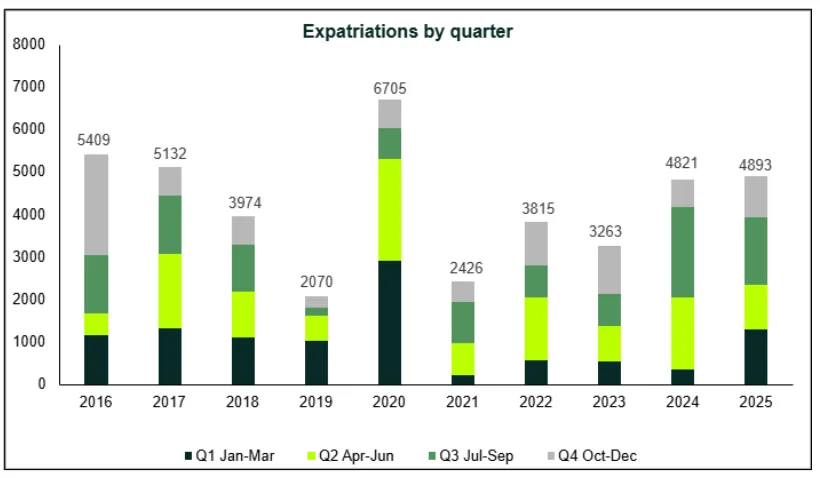
The reasons people give up citizenship or green cards vary, as do the numbers who go through the process each year. The graph below shows expatriations since 2016, where the individual has been required to file an expatriation return. As this is linked to the return filing, it is actually 2019 which was the peak year for embassy appointments, with the forms then filed in 2020. The pandemic led to a sharp drop-off in the following year when many embassies around the world would have been closed.
Tax reporting requirements
You may find the US obligations that follow you around the world have become overly onerous and complex. Or you’ve been frustrated when you find the doors of financial institutions close to you because they have no wish to become involved with the IRS.
Accidental Americans
Like many “Accidental Americans” you may have only learned of your obligations when looking to open a bank account and being informed of the US Foreign Account Tax Compliance Act (FATCA).
Recognising this issue, the IRS introduced a specific program for those in such circumstances who wish to get up to date with their tax filings and expatriate. We have written more about this in our insight.
You’ve found a new place to call home
If you were born and brought up in the US but left to work overseas, you may have now settled in a new country but previously not sought to give up citizenship due to your US ties and the possibility of going back in the future. If the time comes when you know you’ve found your new home and moved for good, then renouncing your citizenship could help to simplify your life and create new opportunities for investments without the complications of US tax and reporting requirements.
You are returning home
Conversely, it may be that you made a career for yourself in the US and acquired a green card or citizenship during your time in the US but are now returning to your home country for good.
The tax consequences of expatriating
Before beginning the expatriation process, it is important to understand whether you may be classified as a covered expatriate, as this can have significant tax consequences.
One essential point before beginning the expatriation process is that you must have another citizenship you can rely on going forwards – it is not an option to become stateless.
If you are a green card holder, once you’ve held the card for at least eight years then should you give it up, or have it revoked, then you’ll be subject to the same rules as US citizens who relinquish their citizenship.
What type of expatriate are you?
Consideration should be given as to what kind of expatriate you will be; whether you would be a ‘covered expatriate’ or not.
Covered expatriate
A covered expatriate is someone who meets one of the following criteria:
Your average US net income tax for the preceding five years is more than a specified amount that is adjusted for inflation ($211,000 for 2026).
Your net worth is $2 million or more on the date of your expatriation.
You fail to certify that you’ve met your US Federal tax obligations for the preceding five years.
If you are a covered expatriate, then there is both an immediate and a long-term tax consequence to expatriation.
You are subject to a deemed disposal of all of your assets based on their market value the day before you expatriate. An inflation adjusted exclusion is then applied ($910,000 for 2026) and any resulting gain is subject to Federal tax at the relevant tax rate. Where this can cause significant problems is that it presents a dry tax charge in the US, with funds being needed to cover the US tax levied but without the sale of the asset itself. Furthermore, when the assets are sold in the future then it is possible that the country of residence will also seek to tax any gains at that time and without giving any relief for the US tax previously incurred. This can result in double taxation.
Additional rules can also bring deferred compensation, pensions, and similar items into tax at the point of expatriation.
In addition, any US person (including US citizens, green card holders and US residents) in receipt of a gift or bequest from a covered expatriate is subject to tax at the highest US gift or estate tax rate in effect at the time of the transfer (40% for 2026). This could easily be an issue for a green card holder who had children born while in the US, who will have picked up their own US citizenship from birth.
Non-covered expatriate
If you do not meet the above criteria, then you will be a non-covered expatriate, and you will not have the tax burden of the exit tax or the accelerated taxation of deferred income items.
Dual citizenship
If you have held dual US and other country citizenship from birth and are now resident in that other country when you expatriate, then you may qualify for an exception to the covered expatriate rules.. You’ll still have the reporting obligations, but the tax exposure is significantly reduced.
Planning your expatriation?
There is planning available to avoid or mitigate the tax impact of expatriation, so we recommend discussing the matter with one of our US tax experts before booking an appointment at your local US embassy, to avoid any surprises.
Fill out the form below and one of our US tax experts will be in touch to discuss your unique requirements and how we can be of help.
Contact us
We're here to help - whether you have a question, need advice, or want to tell us about your requirements.