
LLP or LTD - What’s the best structure for your business?
17 May 2023 • Corporate Audit • Financial Services • Insight
Written by

This is becoming an increasingly hot topic. Business owners are identifying factors making one structure more attractive than the other; be it succession planning, employee engagement or identifying potential research and development tax credits.
Succession planning – the new issue affecting preferred structures
Historically, traditional partnerships and LLPs have been the preferred structure for professional practices. Investing partner capital into a business involves relatively little red tape compared to the buying and selling of a company’s share capital. Similarly, attributing profit shares among the partners can be more tax efficient than paying a salary and more flexible than paying dividends.
Remuneration of partners/directors
In an LLP, partners pay income tax on their profit allocation whether or not those profits have been drawn out of the business. Contrast this with a company, where the business pays corporation tax on its taxable profits; shareholders pay income tax on dividends paid in the year and directors pay income tax on their salary and bonus paid in the year.
Corporation tax rates are lower than income tax rates, meaning that it can be more tax efficient to keep working capital (i.e. undrawn profits) in a company rather than in an LLP. However, there is no longer a material saving between dividends and profit share.
Research and development (R&D) tax credits
R&D tax credits are an incentive provided by the UK Government to encourage companies to undertake development activities, but it’s not available for LLPs. The relief is based on the R&D costs that your company incurs. It can be used either to reduce the amount of tax that your company pays, or can lead to a cash payment from HMRC.
R&D tax credits are not just for tech companies and the scope is wider than you might think. Many businesses are constantly investing in software improvements or developing novel applications to better service their customers. This work may be seen as a back office function within the business and not a core part of the brand or product offering. However, these IT and tech developments can be eligible for R&D tax credits.
An R&D claim can lead to a reduction in corporation tax payable or a cash payment from HMRC. Architects and surveying firms are just two sectors where credits are under-claimed. This should be considered when it comes to your corporate structure.
Employee Ownership Trust (EOTs)
Long gone are the days of employees remaining at one firm for their whole career. Finding innovative ways to incentivise and retain key staff helps to secure the future of the business.
Employee ownership trusts were introduced by the Government in September 2014 as a means of giving company employees a stake in the business (e.g. by owning shares) and having a say in how it’s run, known as employee engagement.
In our experience, an EOT can suit forward-thinking companies that want to engage their workforce and encourage the next generation of leaders. It can provide a tax advantage to owners who hold a majority of shares in the business as, so long as the qualifying conditions are met, there is capital gains tax relief on the disposal of a controlling interest. For employees, there are tax-free bonuses of up to £3,600 per year, per employee, according to legislation at the time of writing. The main disadvantage of an EOT is that the price is fixed at the time of the sale and if the value of the company were to subsequently increase, shareholders will not benefit from this.
This is just one of a number of ways in which ownership can be expanded to a company’s employees and it is the method we most commonly see.
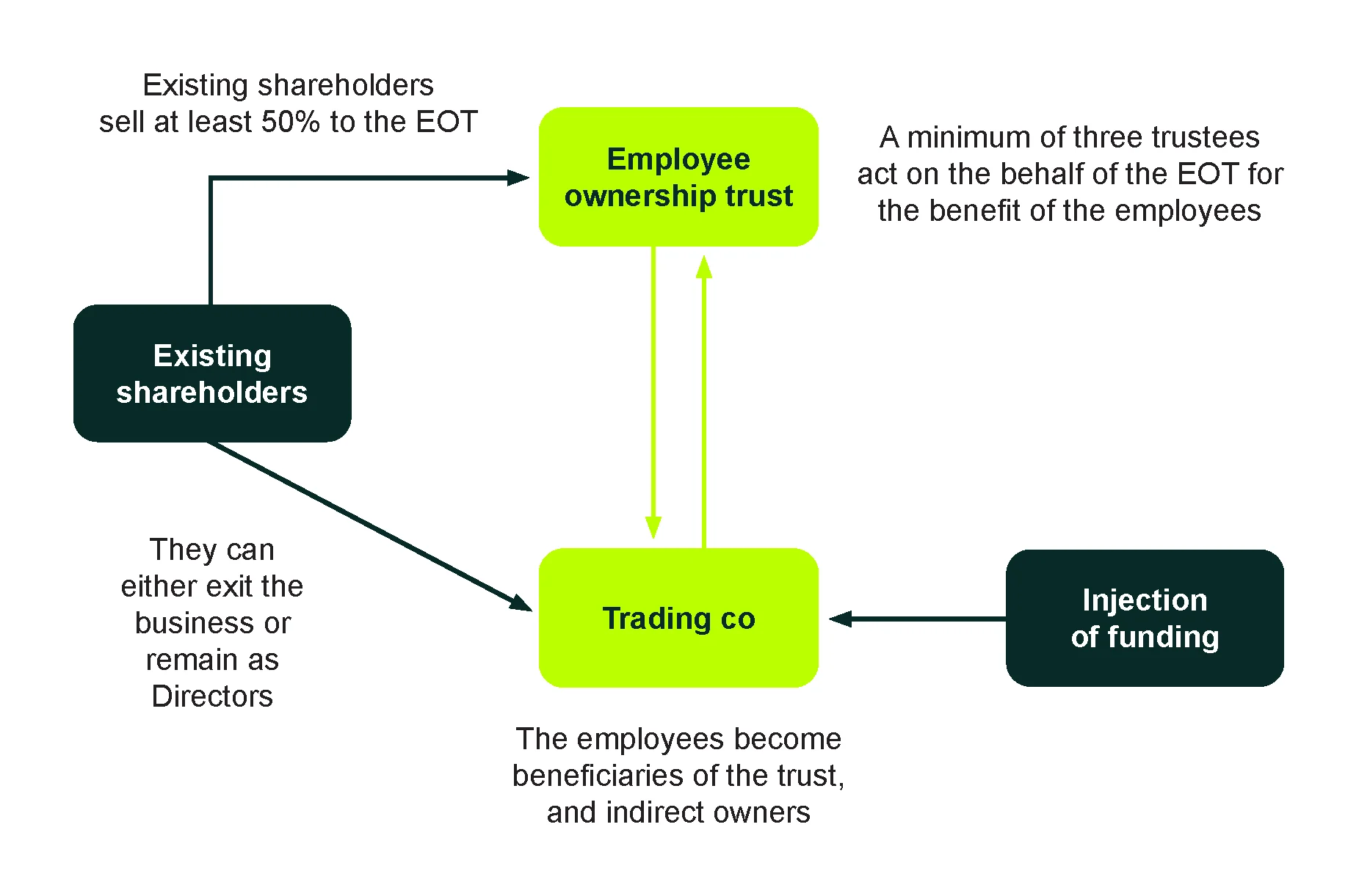
Conclusion – needs of the business before tax benefits every time...
While there can be tax benefits to being a limited company, the decision to change structure should focus on the culture and needs of the business, rather than being tax driven.
Flexibility on remuneration strategy of salary, bonuses and dividends as well as retaining profits in the company. Companies can make R&D claims which are a form of corporation tax relief. | Dividends are usually paid in line with individual shareholdings. There are limitations on the availability of Entrepreneurs’ Relief on the sale of company shares. |
Profit shares are allocated in accordance with the LLP agreement and can be easily varied. It is simple to bring in new partners and it is straightforward for retiring partners to exit. | Income tax on profit shares is less flexible and more expensive when there are a lot of undrawn profits in the LLP. LLPs cannot make an R&D claim. |
Contact us
We're here to help - whether you have a question, need advice, or want to tell us about your requirements.